


Table of Contents
- What to Look for in a Bulk Workwear Supplier
- Workwear Supplier Comparison: Key Evaluation Criteria
- Workwear Size Guide for Employees: Getting Fit Right
- Custom Logo Workwear: Branding Your Bulk Order
- Branded Workwear in Bulk: Pricing and Value
- Durability and Quality Standards for Workwear
- Turnaround Times and Delivery Reliability
- Frequently Asked Questions
Last Updated: October 21, 2026
What to Look for in a Bulk Workwear Supplier
Choosing the right bulk workwear supplier shapes how your team presents itself to clients, customers, and the public. When you're outfitting dozens or hundreds of staff members, the stakes are higher than a single purchase, consistency, durability, and reliable delivery directly affect your brand reputation.
The best suppliers combine three core strengths: reliable product quality that survives repeated washing and heavy use, fast turnaround times that don't derail your launch schedules, and transparent pricing with no hidden fees appearing at checkout. At Corporatewear UK, we've worked with procurement managers, operations heads, and business owners across construction, hospitality, logistics, retail, and education for over 25 years. What separates suppliers that get rehired from those you never call again is how they handle the details, consistent embroidery quality across batches, accurate sizing guidance to avoid costly returns, and honest communication about what's possible within your timeline and budget.
A bulk workwear supplier isn't just a vendor who ships clothes. They're a partner who understands that your uniform order represents your company's identity. When you order 50 polo shirts with your logo, you're not buying fabric, you're buying the ability to walk into a room and have your team look unified, professional, and intentional.
Workwear Supplier Comparison: Key Evaluation Criteria
The difference between a workwear supplier that delivers and one that disappoints often comes down to how they handle five measurable criteria.
Quality and durability tops the list. Industrial workwear takes punishment, repeated washing at high temperatures, stretching, staining, and wear in demanding environments. Our Workwear polo with Superwash® 60°C is designed for exactly this, hardwearing polycotton that tolerates industrial laundering without degradation.

Turnaround time and reliability separate professional suppliers from amateurs. A supplier who promises five-day delivery but ships in three weeks has just cost you a client event, a product launch, or a seasonal hiring window.
Embroidery and printing consistency matters more than most buyers realise. Your first batch of uniforms looks immaculate. The second batch, six months later, has embroidery that's noticeably looser or positioned differently. This happens when suppliers don't maintain strict quality controls across production runs.
Sizing accuracy and fit guidance prevents the nightmare of ordering 50 uniforms and finding half don't fit. Our Polycotton twill workwear trousers feature an expandable waistband specifically designed to accommodate varied sizing without custom alterations.

Transparent pricing means no surprises at checkout. Setup fees, artwork charges, embroidery costs, and delivery fees should be quoted upfront. A supplier who lists a base price of £15 per shirt but adds £3 in hidden fees per unit has just inflated your cost by 20% without permission.
| Evaluation Criteria | What to Check | Red Flag |
|---|---|---|
| Quality & Durability | Fabric content, wash temperature rating, reinforcement details | Vague descriptions, no washing guidance |
| Turnaround Time | Written confirmation of delivery date, artwork approval speed | Promises under 3 days without embroidery detail |
| Embroidery Consistency | Same files used across batches, quality standards documented | Different appearance between orders |
| Sizing Accuracy | Detailed size guides, fit recommendations, alteration options | Generic sizing with no guidance |
| Transparent Pricing | Itemised quotes with all fees included | Hidden setup or embroidery charges |
Workwear Size Guide for Employees: Getting Fit Right
Sizing mistakes multiply costs. Order 50 uniforms in the wrong sizes and you've wasted budget, frustrated your team, and created a logistics nightmare for returns and replacements. Getting fit right requires three steps: understanding how different garment styles fit, measuring your team accurately, and allowing for individual variation.
Start by recognising that workwear styles fit differently. A classic-fit polo is cut for a relaxed, comfortable wear, it's forgiving across the chest and shoulders. A slim-fit trouser is tapered through the leg and sits closer to the body. Our WX2 stretch work trousers in slim fit use four-way stretch fabric and an elasticated waist specifically to accommodate movement and varying body shapes without excess fabric bunching.
Measure your team properly. Don't rely on staff to self-report their sizes, people often guess or choose sizes that don't reflect their actual measurements. Use a tape measure to record chest, waist, inside leg, and sleeve length. Compare these measurements against the supplier's size chart, not a generic chart. Each manufacturer's sizing varies; what's a large at one supplier might be an extra-large at another.
Allow for variation within your team. If your team ranges from size 8 to size 20, ordering everyone in a medium won't work. Discuss with your supplier whether they can accommodate a size mix within a single order, or whether you need to place separate orders by size. Most bulk suppliers handle mixed sizes without penalty, this is standard practice.
Custom Logo Workwear: Branding Your Bulk Order
Your logo on your team's chest transforms a generic uniform into branded workwear that reinforces your company identity every time your staff interact with a customer or client. The quality of that logo, its clarity, colour accuracy, durability, and consistency, determines whether it enhances your brand or detracts from it.
Embroidery uses thread to create a raised, textured logo that's exceptionally durable and looks premium. Screen printing applies ink directly to fabric, allowing for larger, more detailed designs and full-colour artwork.
Ask your supplier about artwork setup. A supplier who offers same-day artwork approval, like Corporatewear UK does, means your logo is approved and production begins immediately, no week-long delays waiting for feedback.
Colour matching is critical. Your brand colours need to translate accurately from your logo file to thread or ink. Ask whether the supplier can provide a sample or colour swatch before full production. A logo that's supposed to be deep navy but arrives as pale blue looks like a mistake, not a professional brand asset.
Placement matters too. A chest logo on a polo shirt creates a different visual impact than a back-shoulder placement. Discuss options with your supplier and request a mock-up or sample garment showing exactly where your logo will sit. This prevents surprises when 50 uniforms arrive with your logo positioned differently from you envisioned.
Workwear polo with Superwash® 60°C (classic fit) →
Branded Workwear in Bulk: Pricing and Value
Bulk pricing isn't simply about getting the lowest cost per unit. It's about understanding what you're paying for and ensuring the value justifies the expense. A £12 polo shirt that falls apart after six months costs more than a £18 polo shirt that lasts two years.
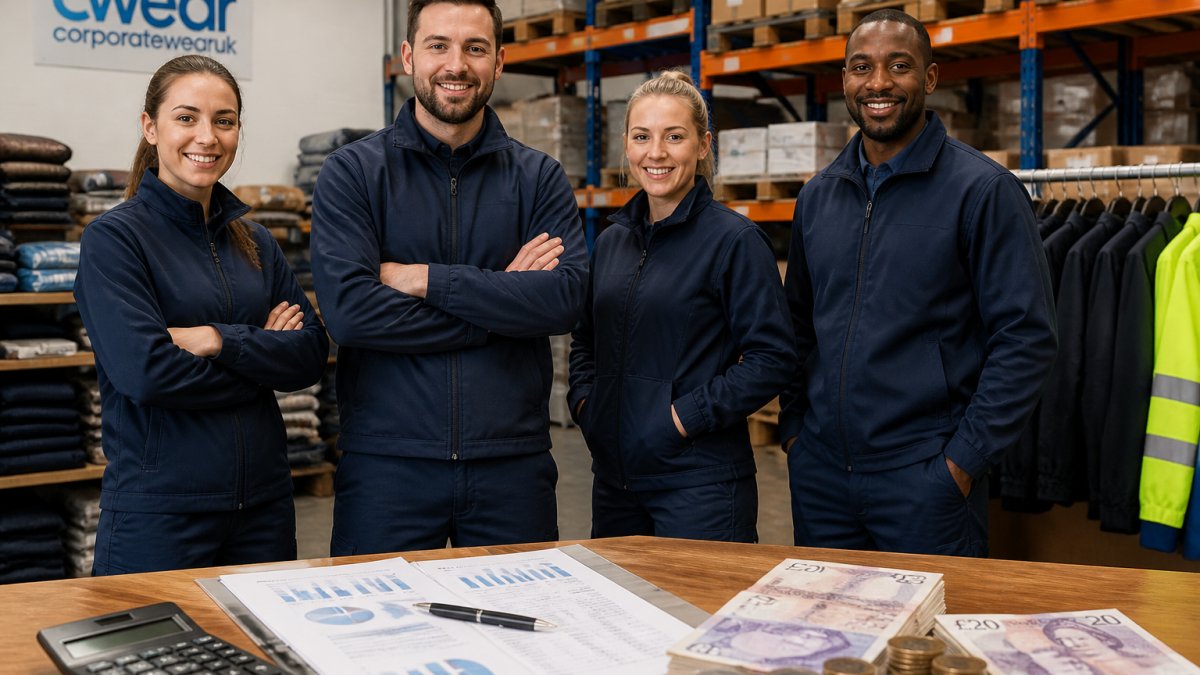
Pricing typically breaks down into three components: garment cost, customisation (embroidery or printing), and delivery. Garment costs decrease with volume, 100 units cost less per piece than 20 units. Customisation costs depend on complexity; a single-colour chest logo costs less than a multi-colour back design.
Our pricing reflects this structure. A Workwear t-shirt starts at £14.11, featuring double-layered shoulder panels and enzyme-washed ringspun cotton designed to withstand repeated industrial washing. The Pro universal jacket is priced at £30.51 and includes water-repellent micro poplin fabric with stretch inserts and concealed embroidery access for easy customisation.

What separates value from expense is longevity and consistency. When your team's uniforms look professional, fit properly, and survive repeated washing without fading or shrinking, staff morale improves and your brand image strengthens. That's value.
Ask suppliers to break down their pricing transparently. What's included in the per-unit cost? Are embroidery setup fees separate? Is delivery included or additional? A supplier who itemises every charge builds trust. A supplier who quotes a "total" without detail is hiding something.
Durability and Quality Standards for Workwear
Workwear quality is measurable. It's not subjective opinion, it's fabric composition, stitching standards, and how garments perform under real-world conditions.
Fabric content determines durability. Pure cotton breathes well but wrinkles easily and can shrink. Polycotton blends (typically 65% polyester, 35% cotton) resist wrinkles, shrinkage, and fading while maintaining breathability. Our Polycotton twill workwear trousers use this blend specifically for workwear environments where durability matters more than pure natural fibre.
Stitching quality separates workwear from casual clothing. Industrial-grade seams use reinforced thread and closer stitch density, which means seams don't split under stress. Look for double-stitched seams, particularly at stress points like underarms, crotch, and pocket corners.
Wash temperature tolerance matters in industrial settings. Many uniforms are laundered at 60°C or higher for hygiene and efficiency. Garments that shrink or fade at these temperatures become unusable within weeks. Our Superwash® 60°C technology is specifically engineered for this, the fabric is treated to tolerate high-temperature washing without degradation.
Turnaround Times and Delivery Reliability
A five-day turnaround is only valuable if it actually happens. Delays in artwork approval, production, or delivery mean your uniforms arrive after you need them, which defeats the entire purpose.
Reliable suppliers commit to specific dates in writing. They account for artwork approval time, production time, and delivery time separately, so you understand where delays might occur. They communicate proactively if issues arise, rather than going silent and hoping you don't notice the delay.
Corporatewear UK guarantees 5-7 day turnaround with same-day artwork approval. This means your logo goes live immediately and production starts without waiting. Delivery across the UK is included, so your uniforms arrive ready to use.
Ask potential suppliers these specific questions: What's included in your turnaround time, does it include embroidery setup and artwork approval, or only production and delivery? What happens if you miss the deadline, do you offer compensation or expedited delivery at no charge? Can you provide references from recent clients who can confirm you met your delivery dates?
Frequently Asked Questions
How do I choose a bulk workwear supplier for my business?
Start by assessing your core needs: garment types (polos, t-shirts, trousers, jackets), team size, and branding requirements. Evaluate suppliers on turnaround time, quality consistency across batches, pricing transparency, and their ability to handle sizing variations. Request samples before committing to large orders, and check whether they offer embroidery or printing services. Ask about their experience with businesses similar to yours, whether construction firms, hospitality groups, or retail chains, to ensure they understand your industry's durability demands.
What should I look for when buying branded workwear in bulk?
Prioritise fabric durability, care instructions, and whether garments can withstand industrial washing at 60°C. Check that the supplier offers competitive per-unit pricing at your order volume and transparent pricing with no hidden setup fees. Confirm they can provide multiple sizes and styles in a single order without delays. Ask about their embroidery quality control process and whether they guarantee consistency across repeat orders. Verify their lead time matches your needs, most quality suppliers offer 5-7 day turnaround, but confirm this in writing before ordering.
Can workwear suppliers add a company logo to bulk orders?
Yes, most bulk workwear suppliers offer embroidery and printing services as standard. When requesting custom logo work, provide high-resolution artwork (preferably vector format) and specify placement on the garment. Ask whether setup fees apply and whether the supplier offers same-day artwork approval to speed up production. Request samples showing your logo on the specific garment style before final production to catch any quality issues early.
What information should I provide when requesting a workwear quote?
Supply your exact requirements: total quantity, garment types and colours, size breakdown for your team, logo specifications (artwork file, placement, size), required turnaround date, and delivery location. If you're unsure of sizing, ask for guidance, many suppliers provide size charts or fit guidance. Specify any special requirements, such as washability standards or stretch fabric preferences. Request the quote in writing with all costs itemised: unit price, setup fees, embroidery or printing charges, and delivery. This prevents surprises at checkout and allows you to compare suppliers fairly.
Selecting a bulk workwear supplier is fundamentally about trust. You're trusting them to understand your brand, deliver consistent quality, meet your deadlines, and represent your company professionally through your team's appearance. Corporatewear UK has built that trust over 25 years by prioritising quality, speed, and transparency. Get a quote today and see how we can equip your team with branded workwear that lasts.


